labelscope: checking the labels that teach computers to read the Herculaneum scrolls

Carson Rodrigues / November 21, 2026
7 min read • ––– views
About 2,000 years ago, Mount Vesuvius buried a library in Herculaneum. The scrolls turned to charcoal. You can't unroll them, so people scan them with X-rays and teach computers to find each layer of papyrus and read the ink on it.
The computers learn from labels: surfaces traced through the scans, many of them by hand. I built a tool called labelscope that checks how well those labels fit what the scan shows.
| Competition | Vesuvius Challenge monthly Progress Prize. Money goes to work that helps more scrolls get read |
| Organiser | The Vesuvius Challenge team (scrollprize.org) |
| When | The August and September 2026 rounds. The prize runs every month until June 2027 |
| Field | August 2026: 15 winners announced on 7 September |
| Result and rank | Not among the August 2026 winners |
| Built in | August to mid-September 2026 |
| Team | Solo, with AI coding agents |
| Money spent | Not tracked in full. The September scan check ran on a rented computer at $0.06 an hour: 163 surfaces in about 20 minutes, about $0.02. The rented machines on 2 September came to about $0.35 |
| Code | github.com/rodriguescarson/labelscope (MIT licence) |
What I built
The team's own Open Problems post says labels are approximate. They can wiggle, drift a little off the true surface, and skip the hard parts. I took those three sentences and tried to turn each into a number you can compute.
A voxel is a tiny cube, the 3D version of a pixel. A patch is a small block of the scan with its label. Here's what labelscope asks.
First, is the test fair? If a practice patch and a test patch share voxels, the test score looks better than it should. Across 1,754 patches in one training set, 28 pairs overlapped. That put 1.5% of the test patches at risk. It's small, and the tool writes a corrected split that removes it.
Second, where does the scan say the sheet is? On 836 of 892 label and scan pairs, the brightest line of the papyrus sat a median of 2.3 voxels from the label. That fits a label placed on the face of the sheet, not through its middle, which is where the writing is. It isn't a mistake. It just matters to anyone who treats the label as the centre of the sheet.
Third, does a traced surface stay on one layer? A surface that jumps to the next layer still lies on papyrus, so the surface looks fine. The giveaway is a seam, a line where it crosses the gap between two layers. I moved one winding across half of a real surface to test it. The dark line along the seam measured 9.1 on the real surface and 36.3 on the altered one.
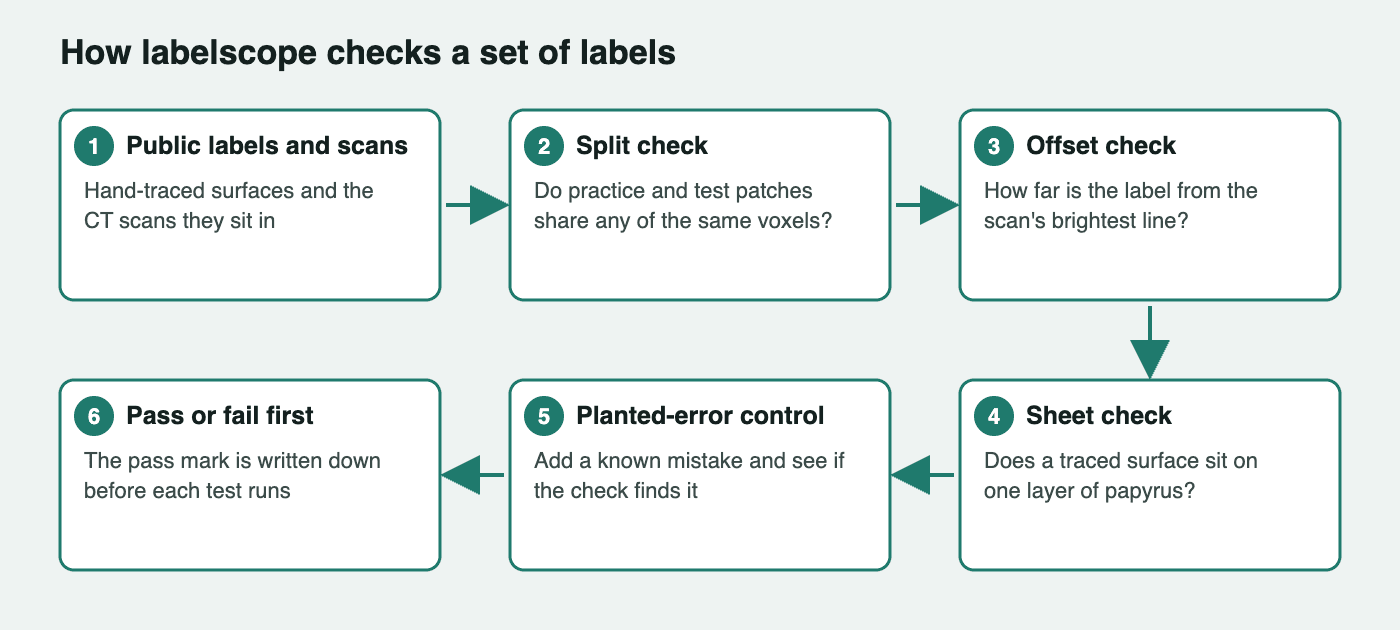
In September I added a simpler check. It asks whether the scan along a surface shows the layered structure of a sheet at all. It scored 257 of the 258 published surfaces. The seam check could judge 114, because it needs the layers to be far enough apart to see.
Research
Primary research. Every number comes from the whole collection, never a sample: all 892 label and scan pairs, all 1,754 patches, and all 258 published surfaces across 7 scrolls.
One result surprised me. Two published tracings of windings 128 and 129 on one scroll (a winding is one turn of the scroll) scored far below their neighbours. The cross-sections showed why. Those windings are the outermost wrap, where the papyrus is fused into a crust and nothing lies beyond. Both tracing runs end there. The team's own ink model finds columns of Greek on windings 126 and 127, and only speckle on 128 and 129.
I'd first called this "not on papyrus". That was too crude, and I corrected it.
Secondary research. I read the Open Problems post and the team's public issues and notes, including one that explains why the usual spiral score can't see a surface that has jumped by a whole winding. I also read Paul Henderson's reply to my first post. He pointed out that brightness near a surface is a weak signal, because fibres leave the sheet and layers separate. My own tests agree with him, and they shaped everything I did next.
How I tested it
I wrote the pass mark down before each test, and committed it to the repo before I had any numbers.
- Does the last piece of a tracing run tend to be the weakest? I guessed yes. It held in 2 of 3 scrolls, so it's not a rule. I reported it that way.
- Does the sheet score find surfaces with no ink? I sorted every published ink picture into text and no text without the surface names showing, and the test failed. Only 4 of 169 labelled surfaces had no text, and the score didn't pick them out. An AI model did the labelling, not a person, so read this as where an AI model sees no letters.
- Can the score predict one contributor's own good and bad ratings of 340 surfaces? I set the bar at 86% and it reached 67%. It failed, and I published that.
I also owe three corrections. I first reported 7,527 overlapping patch pairs, and 91.9% leakage. That was wrong by about fifty times. I'd assumed every patch was the same size, and the files show five sizes. Eight files I called malformed were cut short by my own downloader. And my first corpus had 253 surfaces; the real number is 258.
The tool has about 165 automated tests.
What I learned
- Read sizes from the file, never from the name. That one habit would have saved me two retractions.
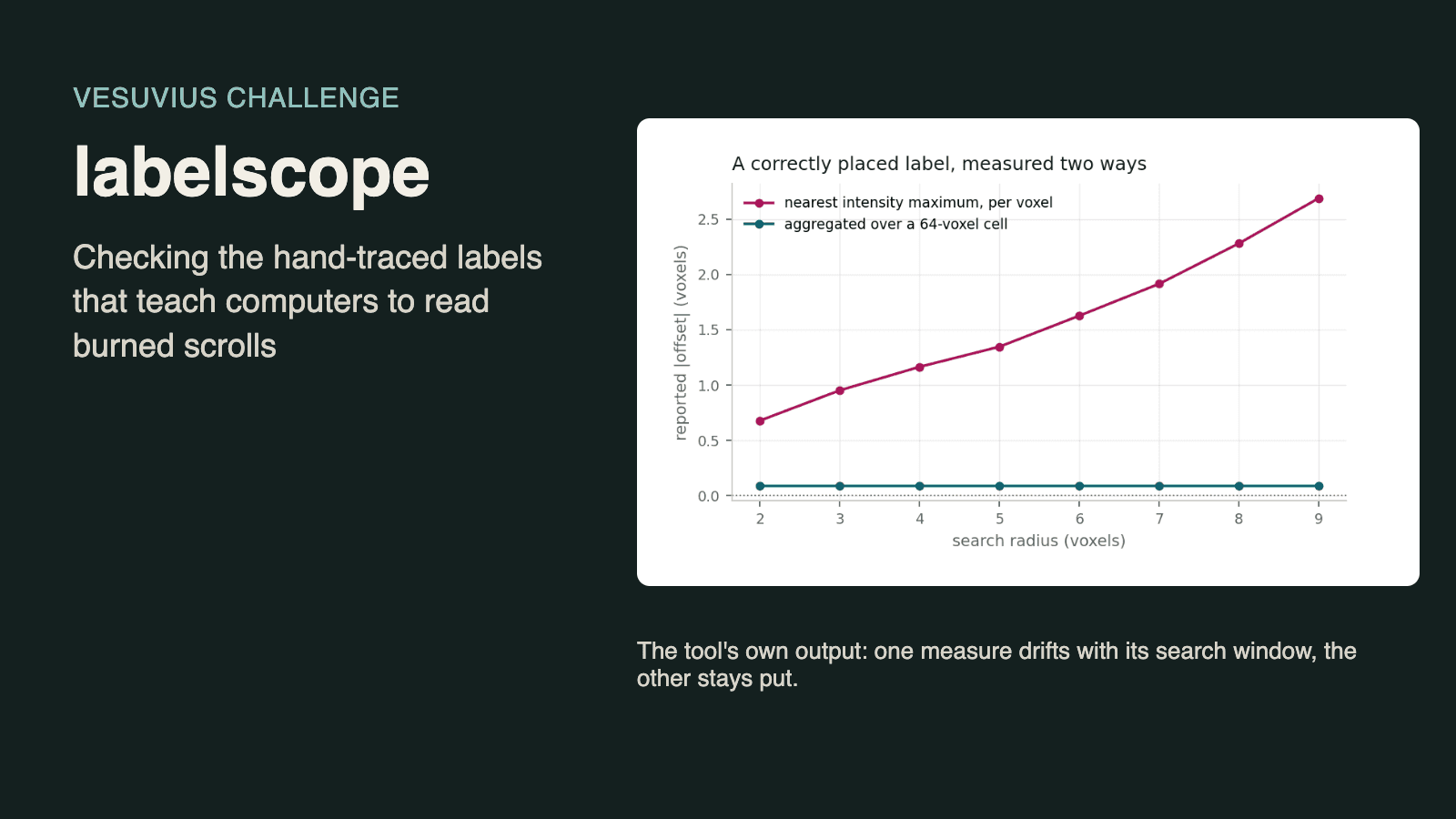
- A measurement can look fine and still be wrong. Searching for the nearest bright point along one voxel's path gave a "drift" that grew as I widened the window. Averaging over a block of surface stayed put.
- Plant a known mistake before you trust a checker. It tells you what the checker can see, and what it can't.
- Say what a tool can't judge. 144 surfaces were out of reach for the seam check, and the report says so.
- A fair failed test is worth publishing. Two of my tests failed outright and one held in only two of three scrolls. Each told me where to stop.
Links
Available · London / UK · senior AI, AI FDE, contract
Building something with AI?
Voice agents, MCP servers, LLM pipelines, agentic workflows — pick a slot, drop a message, or send your email and I'll reply within a day.
Replies within ~24 hours · London, UK · on-site, hybrid or remote