ParkMe: a parking heat map I built for Techgium, and the data I made up

Carson Rodrigues / November 21, 2026
5 min read • ––– views
Finding a parking spot is a small problem that eats a lot of minutes. In 2022 my team took an idea for it to the Grand Finale of Techgium, a competition run by L&T.
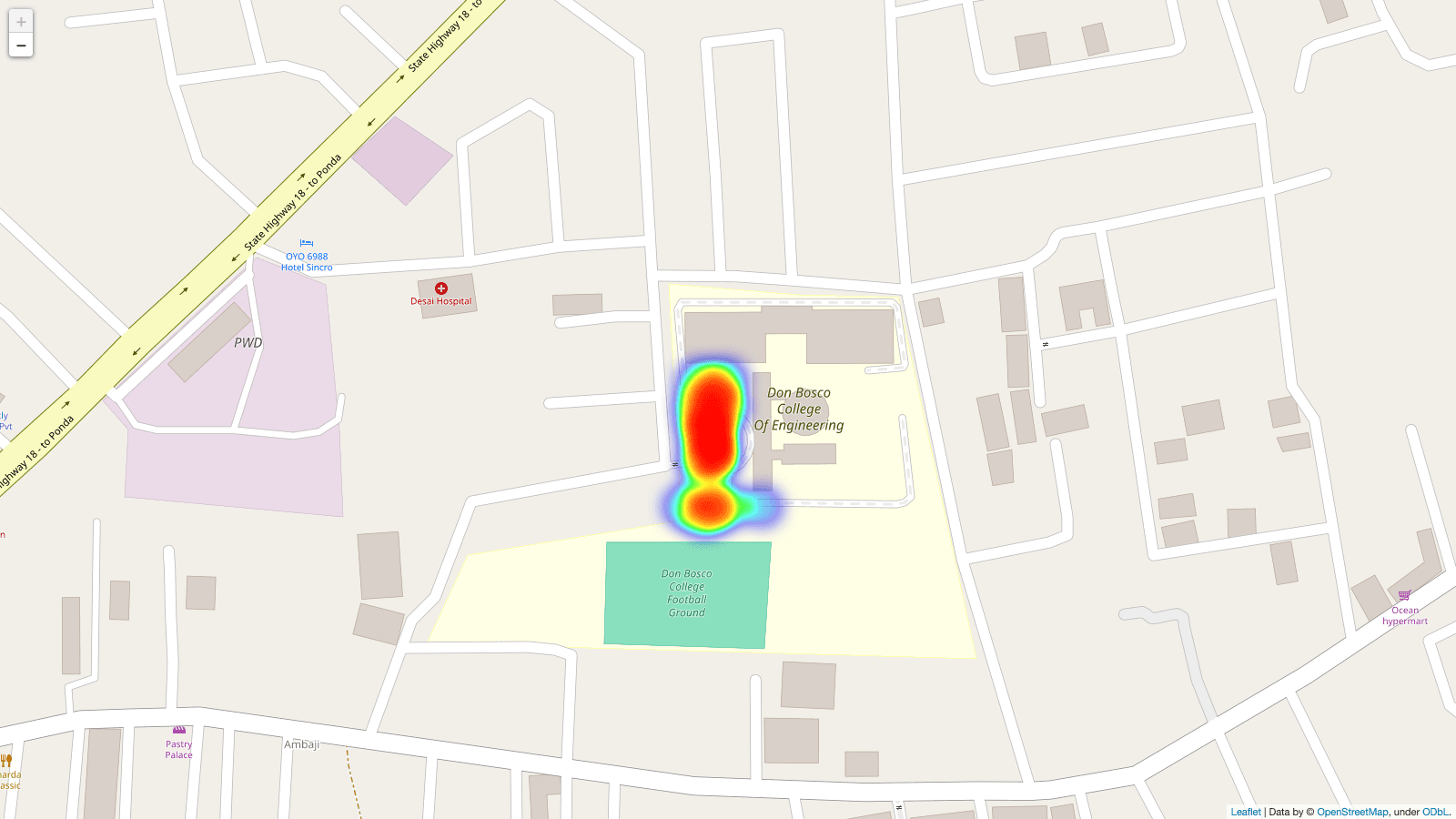
The idea was ParkMe, a map that shows where cars gather in a parking area. The picture above is the map the backend code produces. I rendered it on 21 November 2026 from the output file in the repo, so it isn't a screenshot from the finale.
| Hackathon | Techgium by L&T, Grand Finale |
| Organiser | L&T |
| When | 2022. The finale date isn't in my records. The public repo was created on 10 March 2022 and the backend repo on 16 March 2022 |
| Field | Not recorded |
| Result and rank | Grand Finalist. No placing or prize is recorded |
| Built in | Not recorded |
| Team | Not recorded. My own bio says "we built ParkMe", so it wasn't only me, but I have no list of names |
| Money spent | Not tracked |
| Code | github.com/rodriguescarson/parkme (the web app). The backend repo is private |
What I built
ParkMe came in two parts, in two repos.
The web app is in React. Its home page says "A tool that displays heat map of a parking location." Underneath is a set of map tools built with Leaflet, a map library. They let you drop markers, find your own location, draw shapes and areas, and print the map. The map opens zoomed in to the Don Bosco College of Engineering campus, where I studied. A file in the repo holds 11 shapes drawn on that campus, which I take to be the parking areas. The app also still has a page left over from the tutorial I started from, listing fake users. I never cleaned it up.
The backend is Python, using Django. It reads a table of cars and draws a heat map with a library called Folium. Red means many cars at that spot, blue means few. The page has two sliders, one for the day (1 to 7) and one for the hour (1 to 23).
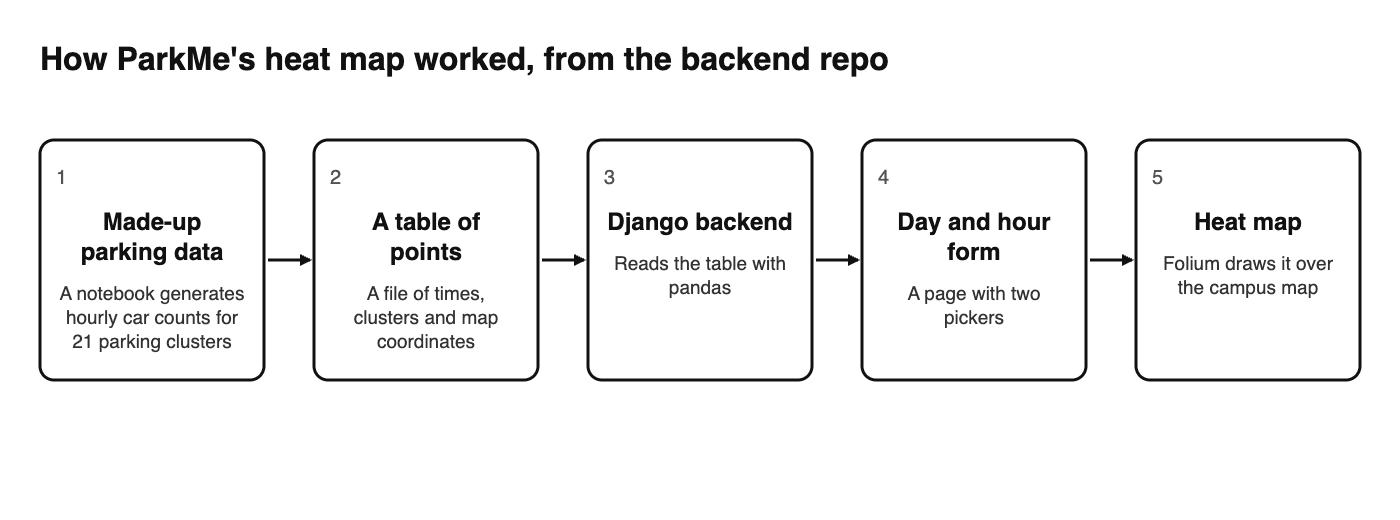
Here's the part I want to be straight about. The table isn't real parking data. A notebook makes it up. It lays out 21 clusters of cars on the campus map and, for each quarter hour across one week of January 2022, picks a number of cars from a bell curve. The mornings (8 to 12) and early evenings (18 to 21) are the busiest, and the nights are quiet. The file the app reads has 11,981 rows, and each row is one car. A comment in the notebook says about 82 cars in total.
So the heat map shows where my script put the cars, not where real ones park. I don't have a record of any sensor, camera or survey behind it.
One more thing from the code. The sliders send a day and an hour, but in the copy I read, the rows aren't filtered by them. The map draws every point. Maybe the finale version did filter. This one doesn't.
Research
Primary research. None is recorded. I have no notes on talking to drivers, or on measuring a real car park.
Secondary research. One source is recorded, and only by accident. A notebook in the backend repo links to a web article on drawing a heat map of taxis in Singapore over time. I seem to have used it as a guide. There's no recorded look at other parking apps.
How I tested it
Nothing is recorded beyond the demo. The web app has only the single test that its starter template ships with, and that test looks for a "learn react" link that the app doesn't have, so I doubt it passes. The backend's test file is empty.
What happened
We reached the Grand Finale. My site lists it as "Techgium by L&T, Grand Finale: built ParkMe", and my CV says "Finalist". That's all I have. I don't know our rank, whether there was a prize, or how many teams were in the final.
What I learned
The honest lesson is about the data. A heat map looks convincing whatever is under it. Mine looked finished, and it ran on numbers I'd invented. If I rebuilt ParkMe today, the first thing I'd do is count real cars in one real car park for one day, even by hand, and use that.
The second is smaller. The sliders were the part a judge would touch, and they didn't change the map in the code I read. A demo works when the thing you can click does something.
The third is that I should have kept notes. Without them I can't tell you the date, the team or the rank, and I'd rather say that than guess.
Links
Available · London / UK · senior AI, AI FDE, contract
Building something with AI?
Voice agents, MCP servers, LLM pipelines, agentic workflows — pick a slot, drop a message, or send your email and I'll reply within a day.
Replies within ~24 hours · London, UK · on-site, hybrid or remote