I built PF Nikaalo to stop Indian PF claims from bouncing. It didn't place.

Carson Rodrigues / November 21, 2026
6 min read • ––– views
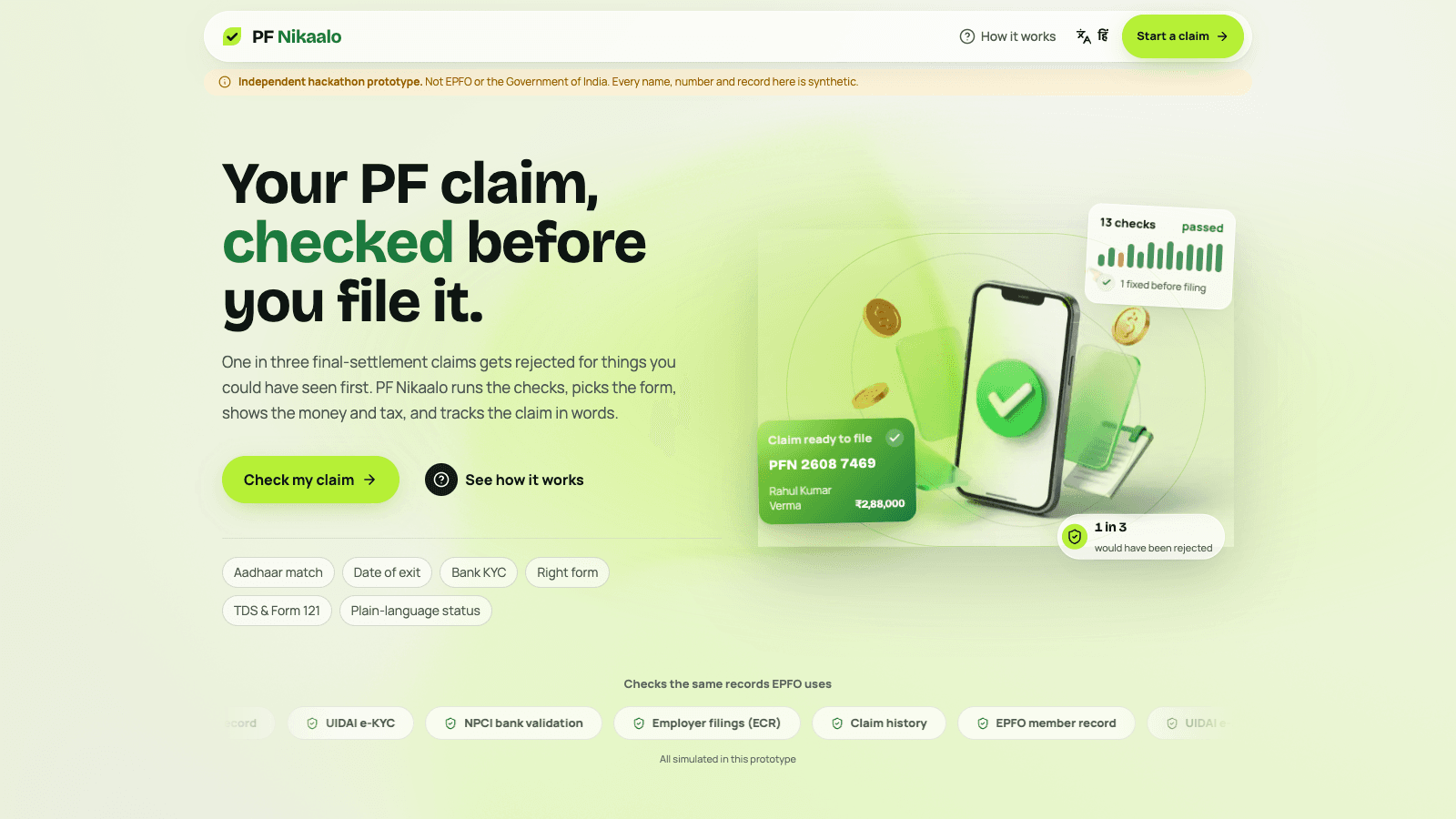
When you leave a job in India, you can ask to take out your provident fund (PF), the retirement savings your employer and you paid into. And when you take it all out at once, about one claim in three gets rejected.
I've been through it myself, after leaving a job.
| Hackathon | Build What Moves India |
| Organiser | Varun Mayya with OpenAI |
| When | August 2026, entries closed 28 August, 8 pm IST |
| Field | Not published |
| Result and rank | Did not place. I have no rank to report |
| Built in | About three days: first commit 26 August, entries closed 28 August |
| Team | Solo |
| Money spent | Not tracked. No entry in my expense ledger, and no model or hosting bill recorded. The site runs on a personal Vercel account on its default web address, so I bought no domain |
| Code | github.com/rodriguescarson/pf-nikaalo |
The hackathon
Build What Moves India was run by Varun Mayya with OpenAI. The brief: pick a digital journey in an Indian public service and rethink it. Entries closed on 28 August 2026 at 8 pm IST, with no grace period.
You sent a live link, a video of two minutes at most, and a summary under 250 words. Judges looked at the problem, the working build, usability, product thinking, end-to-end thinking and honesty. The build also had to use OpenAI's Codex.
What I built
I picked the PF withdrawal. The rejection numbers made the case. Roughly one claim in four is rejected, and for final settlements it's closer to one in three, according to reports in Dataful and the Deccan Herald.
Almost every rejection is for something you could have seen before filing. Your name on the PF record is missing a middle name that your Aadhaar card has. Your employer never marked your date of exit. Your bank account was never verified. The portal accepts the claim anyway, then rejects it about two weeks later with a phrase like "member details mismatch".
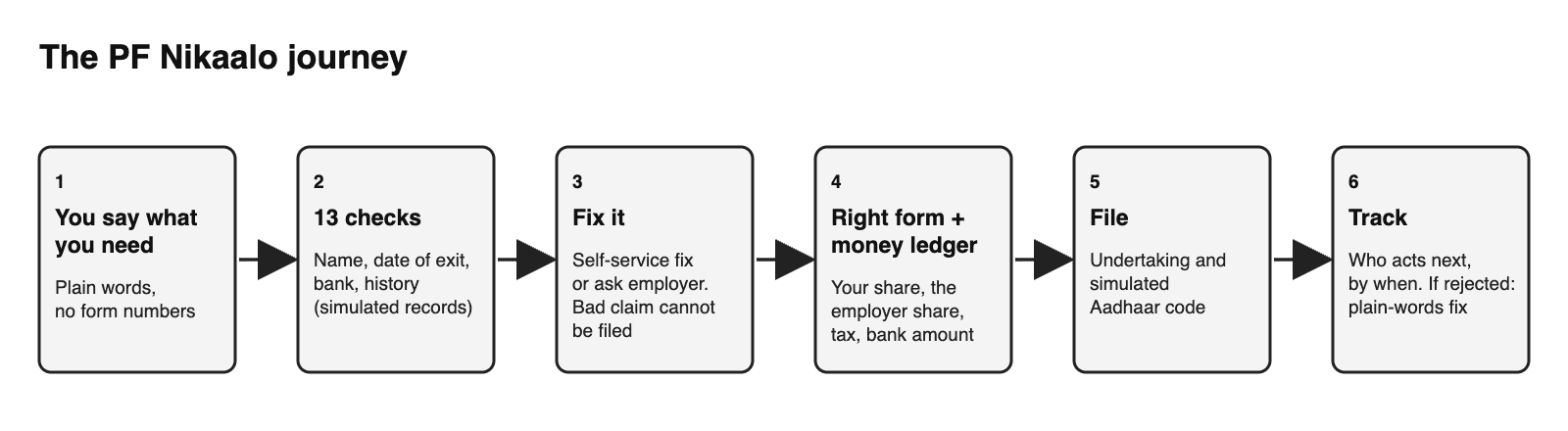
PF Nikaalo ("nikaalo" means "take out" in Hindi) checks first. You say what you need in plain words, with no form numbers. It runs 13 checks against the same kinds of records the real system uses. A failing check is circled, with the evidence, who can fix it, how long it takes, and a button that does the fix when you can do it yourself. A claim that would bounce can't be filed. That's the point.
If everything passes, it picks the right form and explains why. It shows the money as a ledger: your share, your employer's share, interest, tax, and what reaches your bank. Then it tracks the claim in plain words, saying who is acting and what happens next. If a claim is rejected, it turns the official phrase into what to do about it.
It works in English and Hindi. An assistant called Sahayak answers questions from your own record, typed or spoken.
Everything the app talks to is simulated, including the PF record, the Aadhaar check, the bank check and the one-time passwords, and the app says so on every page. The top banner says it's an independent prototype, not the PF office and not the government. The hackathon rules banned posing as an official product. All the data is made up. Four demo accounts are listed on the login page, and any six digits work as the code.
The rules engine is real code, with 94 tests. Codex wrote it against tests I specified, along with the fake backend and the timeline pieces. Each Codex session is its own commit, with Codex credited, so anyone can check what it did. I did the design, the screens, the English and Hindi copy, the assistant and the wiring, with Claude Code.
Research
Primary research. I went through a PF withdrawal myself after leaving a job, and that is where the problem came from. I didn't interview anyone else, and no one outside tested the app.
Secondary research. The rejection figures come from Dataful and the Deccan Herald, which cite the PF office's 2023-24 numbers. I read the hackathon rules closely, because they set what an entry could and couldn't claim. The engine implements the published tax and form rules, including Form 121, which replaced the older tax-exemption forms on 1 April 2026. My notes record no review of other entries.
How I tested it
The rules engine has 94 automated tests. I wrote the tests and the contract first, and Codex implemented the engine until they passed.
The four demo accounts are test cases too. One has a name mismatch, one a missing date of exit, one a failed bank check with an earlier rejection, and one a clean record. English and Hindi text are held in one dictionary, and the build fails if they get out of step. I also ran the loop end to end on the live site: a citizen files a claim, an officer approves it, and the citizen sees the decision.
What I didn't measure: no real users, no real records, and no check of the rules by a PF expert or a lawyer. The one-in-three figure comes from reports, not from my app. I never measured how many bad claims it would catch.
What happened
It didn't place, and I have no rank to report, only that I was not among the winners. I checked the results on 25 October. Nothing I've seen says why, so I won't guess.
What I learned
The problem was the strongest part, and I built too much around it. On the last day I added a real database behind the app, plus a console for PF officers and another for admins, so a claim filed by a citizen could be approved on the other side and show up again in the citizen's status page. It worked, but the brief was about one journey, and that's where the time should have gone.
Plan for your tools to run out. Codex hit its usage limit partway through, with a message to try again weeks later, so I finished with Claude Code. The commit trail is what shows where Codex was used.
Check the public link the way a stranger would. Vercel puts a login wall on new deployments by default. Left on, the link I'd have submitted asked judges to request access, and the rules said the link must open without it. I caught it and turned it off.
Honesty is a scored line, so I gave it a page: what is real, what is simulated, and what it would take to run this for real.
Links
- Live site: pf-nikaalo.vercel.app (use any of the demo accounts listed on the login page)
- Code (public, MIT): github.com/rodriguescarson/pf-nikaalo
Available · London / UK · senior AI, AI FDE, contract
Building something with AI?
Voice agents, MCP servers, LLM pipelines, agentic workflows — pick a slot, drop a message, or send your email and I'll reply within a day.
Replies within ~24 hours · London, UK · on-site, hybrid or remote