Nameproof: checking a brand name before it gets you a legal letter

Carson Rodrigues / November 21, 2026
6 min read • ––– views
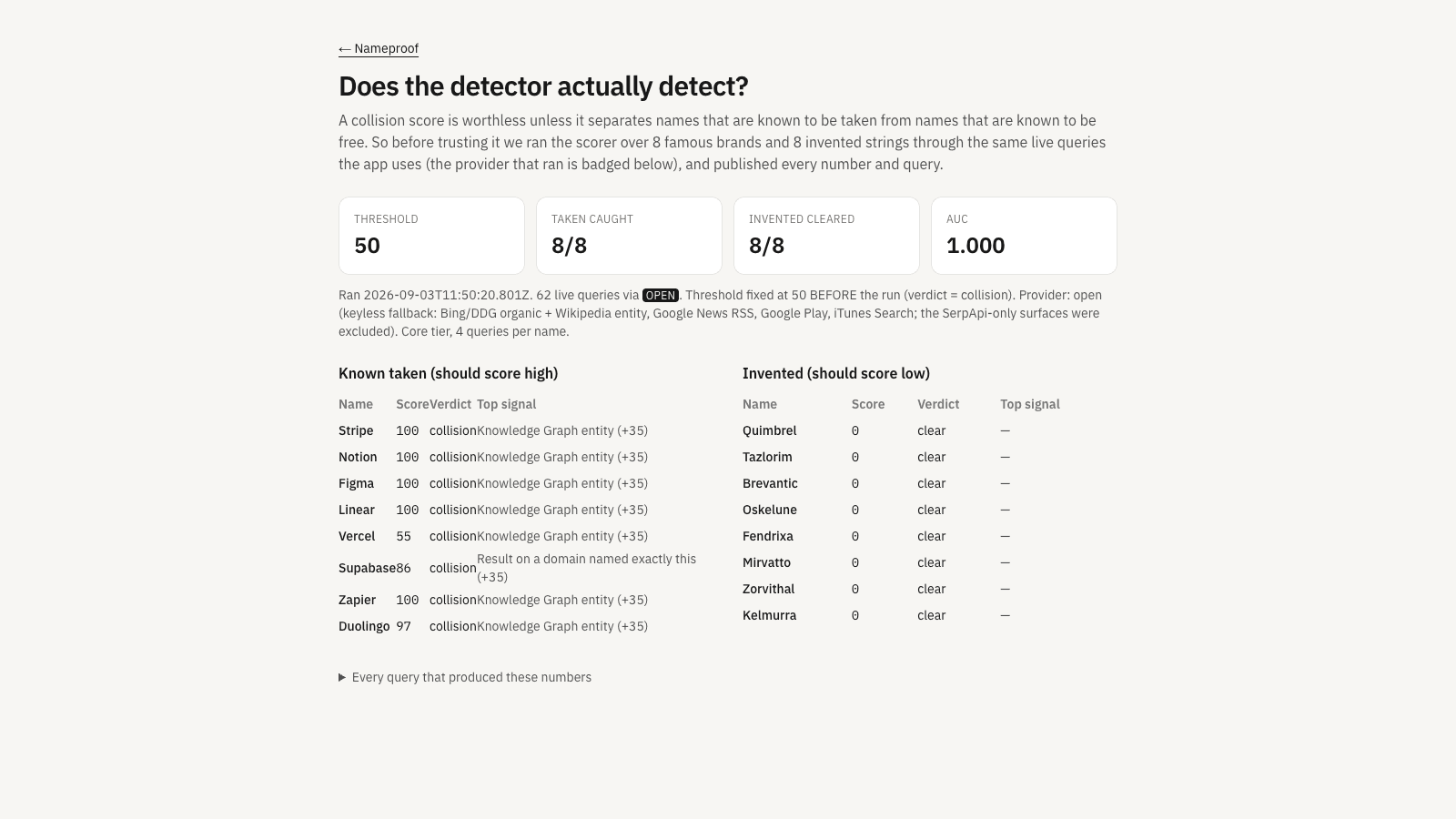
Picking a name for a product is easy. Finding out it already belongs to someone else, six months later, is not.
Nameproof does that check up front. You describe your product, it suggests names, and for each one it looks for who already uses the name and whether the domain is free. The picture above is its calibration page, where it tests itself.
| Hackathon | DevNetwork [API + Cloud + AI] Hackathon 2026 |
| Organiser | DevNetwork |
| When | 2 to 3 September 2026 for my build |
| Track | SerpApi "Best AI Use Case" and the name.com challenge |
| Built in | About 21 and a half hours from the first commit (2 September, 19:55 IST) to the last (3 September, 17:26 IST), 18 commits |
| Team | Solo |
| Money spent | Not tracked. I aimed at SerpApi's free plan of 250 searches a month and name.com's sandbox, which uses fake credit |
| Code | Private. Live at nameproof.vercel.app |
What I built
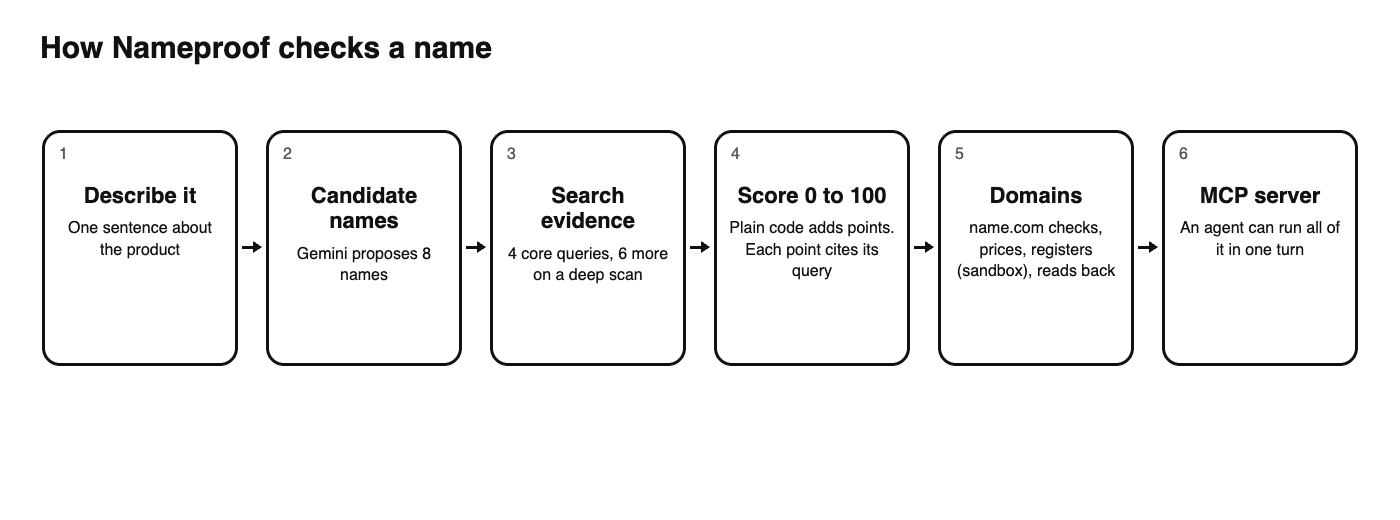
The flow has six steps.
- You type one sentence about your product.
- Gemini proposes eight candidate names.
- For each name you pick, Nameproof gathers evidence from search. SerpApi is a service that returns search results as clean data. A core check runs four queries: Google, Google News, Google Play and the Apple App Store. A deep scan adds six more: a search aimed at trademark registry pages, Google's autocomplete, Google Trends, Google Shopping, YouTube and Bing.
- A scorer turns the evidence into a number from 0 to 100. This is plain code, with no AI deciding. Each point names the signal and links the exact query that produced it, so anyone can re-run it.
- name.com, a domain registrar, checks which domains are free and what they cost. It can also register one in its sandbox, a practice mode, and then set up DNS records, email forwarding and a web redirect. After every write it reads the thing back to confirm it happened.
- The whole loop is also an MCP server. MCP is a standard way for an AI agent to call outside tools. It has four: suggest names, check a name, check a domain, and register in the sandbox. So the same model that suggests a name can clear it in the same turn.
The scoring is a table of points. A Knowledge Graph entity (Google's box of facts about a known thing) is worth 35. A result on a domain named exactly the name is worth 25 or more. An app with the same name on either store, press headlines, a trademark page and a YouTube channel all add points. Under 25 is clear, 25 to 49 is caution, and 50 and above is a collision. A Gemini step then reads only the collected evidence and says whether an existing company uses the name, and whether it's in a related field. If one search source fails, it's left out and labelled, never guessed.
I also built a fallback that needs no key. It uses public sources like Wikipedia, Google News feeds, Google Play and Apple's search. Every evidence row shows a badge for which provider produced it, and the three sources with no free equivalent are shown as unavailable.
Research
Primary research. None. I didn't interview founders or lawyers. My own measurement is the calibration run below.
Secondary research. Before building, I went through the organiser's page, both sponsors' track rules and the winners of earlier editions. One pattern stood out: a sponsor's API used deeply beats several used shallowly. name.com's track favoured many endpoints, so the app uses eleven. Its sandbox has fake credit and won't delete domains, so the app only allows plain registration there and labels the environment on every receipt.
How I tested it
Two kinds of checks.
The first is a calibration page. I ran the scorer over 8 famous brands and 8 invented words, and wrote the threshold of 50 down before the run, so I couldn't nudge it to flatter the result. The run was on 3 September 2026, with 62 live queries, using the keyless fallback provider on the core four-query check. All 8 taken names were caught and all 8 invented names cleared, for an AUC of 1.000. AUC is a score from 0 to 1 for how well a detector ranks the right names above the wrong ones.
Vercel scored lowest of the taken names, at 55, just above the line. Its name is also an ordinary English word, so there was less to match. Stripe, Notion, Figma, Linear and Zapier hit 100. All 8 invented names scored 0.
That shows the scorer handles easy cases. It says little about hard ones, and 16 names is a small set. The numbers come from the fallback provider, so I don't quote any from the SerpApi path.
The second is code tests. Nine tests cover the scorer and the parsers, and I ran them again on 21 November 2026: all 9 pass. Among other things they check that a famous brand is flagged from core evidence alone, that an invented name is cleared, that the deep scan adds signals and caps at 100, that a failed source is excluded, and that the Gemini step adds points only above a confidence bar. A GitHub Actions job runs the type check, the tests and a build in fixture mode, which uses recorded responses so nothing needs a key. I did not re-run the registrar steps against name.com in this check.
What I learned
Search results are a better input for an AI classifier than the AI's own memory. When I asked Gemini what it "knew" about a name, the answers were hard to audit. When I handed it the search results and asked one narrow question, they were easier to trust and to check.
A published threshold is worth the discipline. Writing 50 down first is what makes "8 out of 8" mean something.
Exact match means different things in different places. A Knowledge Graph hit, a result on the brand's own domain and an app with the same title are three different facts, so each got its own signal and weight.
The limits are plain. This is a pre-screen, not trademark clearance. A registry page that turns up in search is a hint, not a search of the register. Google Trends gives only a relative number, so I compare each name to a fixed anchor term.
Links
Available · London / UK · senior AI, AI FDE, contract
Building something with AI?
Voice agents, MCP servers, LLM pipelines, agentic workflows — pick a slot, drop a message, or send your email and I'll reply within a day.
Replies within ~24 hours · London, UK · on-site, hybrid or remote