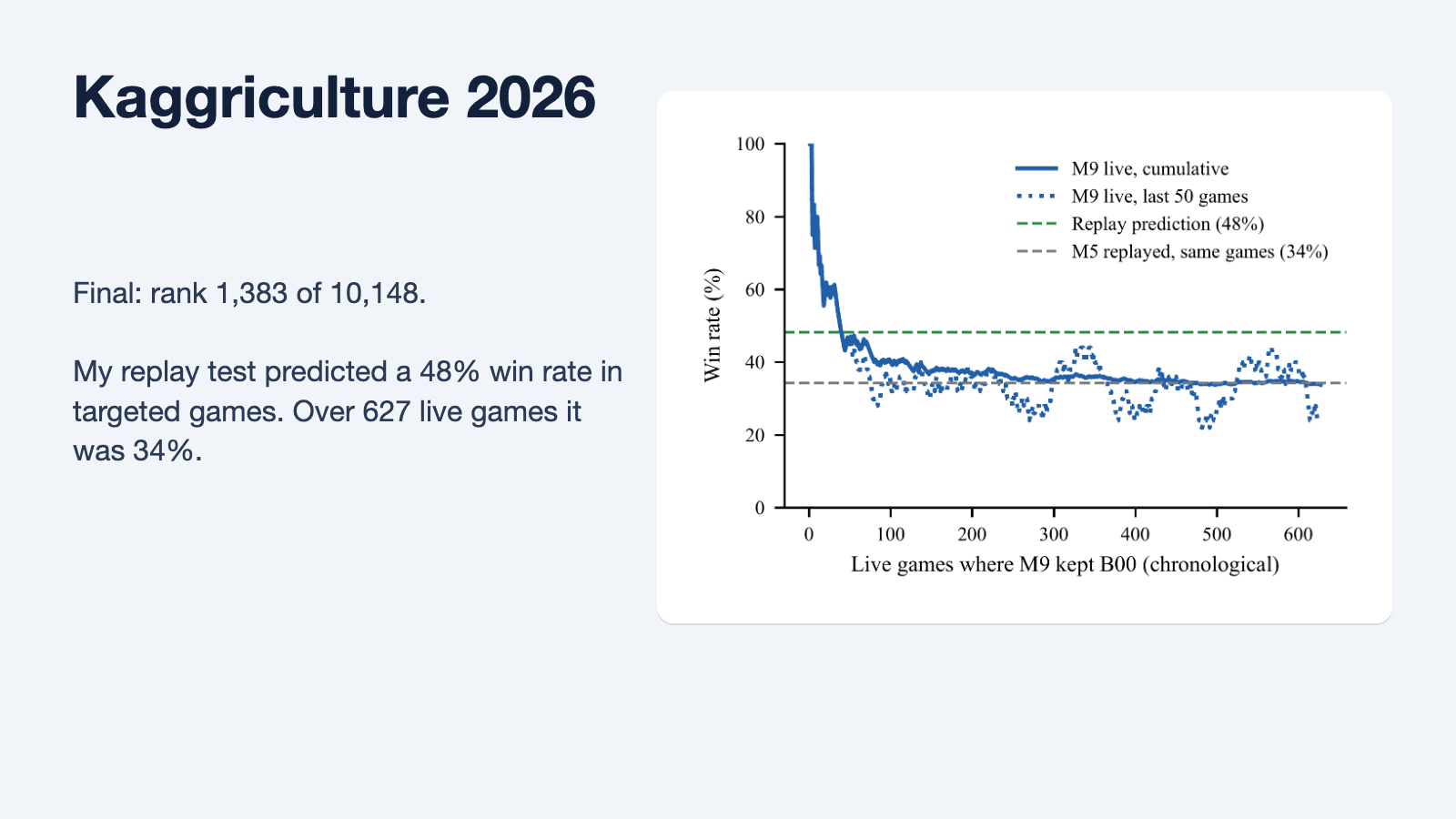
My farming bot's test predicted a 16-point gain. The live games showed zero.

Carson Rodrigues / November 21, 2026
7 min read • ––– views
In Kaggriculture you don't play. You write a bot that runs a small farm for 30 game days, sells what it grows into a market it shares with another bot, and plays that other bot, game after game, all day.
I had a test that told me which changes to my bot would win more games. I trusted it. Then the real games came in.
| Competition | Kaggriculture, a farming simulation where submitted bots play each other. $5,000 to each of the top 10 |
| Organiser | Kaggle, with Google |
| When | I started on 24 September. Submissions closed 30 September 2026. Games kept running until 14 October |
| Field | 10,148 teams |
| Result and rank | Final board: rank 1,383 of 10,148, score 4,337.8. No medal (bronze ended at rank 1,014). The public board showed rank 1,420 and 1,734.9 |
| Built in | About one week |
| Team | Solo, with AI coding agents |
| Money spent | Partly tracked. About $8 on rented computers by 25 September: a 32-core machine at $0.96 an hour for simulations and a $0.12 an hour box to watch the board. The cap I set was $60. Later spend and AI model calls (limited to a $50 key) weren't recorded |
| Code | Private |
What I built
The field was crowded with copies. Many public bots, shared under an Apache licence, did almost the same thing. So my first move was to find the best of them and improve it. Three people's work carried most of that: destbreso shared a dataset with 95 public bots and an exact copy of the game engine, koshinm and arsgorynich shared strong bots, and ashok205 shared an archive of about 25,000 top-ranked games.
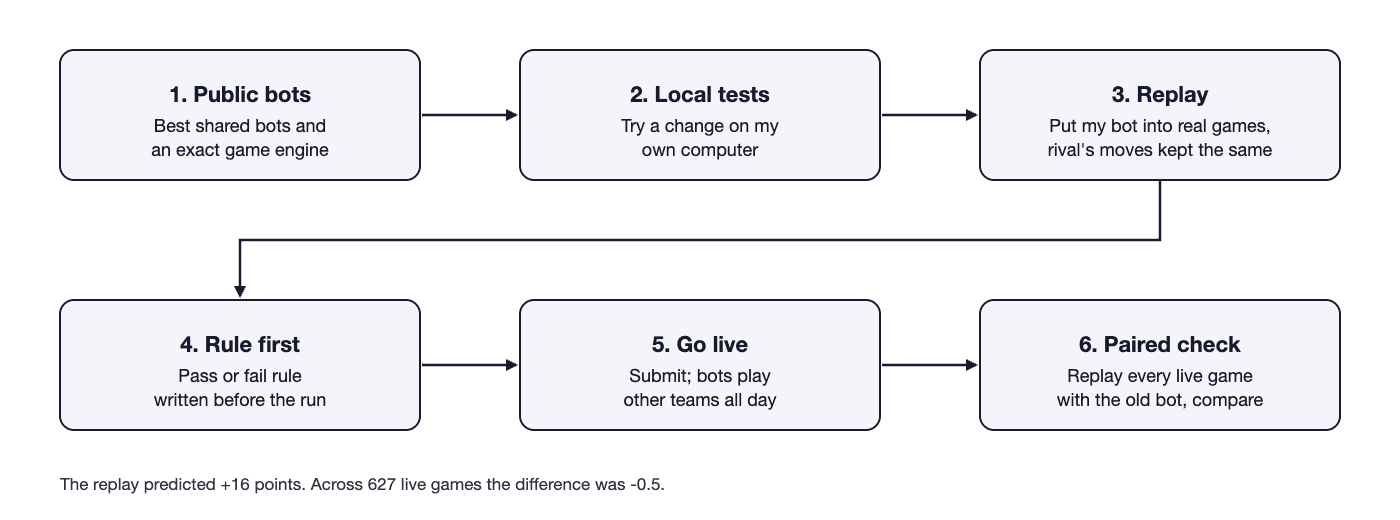
I tested changes on my own computer with that engine, then sent the winners in. It took a long run of versions, ending with M9.
When I looked at where my best bot, M5, lost, 244 of its 290 losses (84%) were to near-copies of public bots in towns without a yarn shop. So the last bot, M9, was a pair: it started as a different public bot, and kept playing as that bot only if the rival was mirroring my moves. Otherwise M5 took over. My final entry was M9 plus a plain M5.
Research
Primary research. This is where most of the week went.
I built a test I called a replay. Take a game that really happened, keep the rival's recorded moves, and swap my new bot into my seat. It reproduced 540 of my 543 real games exactly, so I thought it was safe to trust.
I also looked for why games were won. A game is decided by the gap between my profit and the rival's, because we sell into the same market. A unit that the rival also wants to sell is worth far more to me: a melon sold from that contested supply was worth about $290, wool $214, milk $150 and a strawberry $126, against $51 for an egg and about $32 for wheat. That rule predicted the sign of a change's effect 90% of the time on games it hadn't seen.
And I tried to go bigger. I wrote a new bot engine from scratch. It won 0 of 800 games against my best bot. Later attempts to reach the top 10 failed too, and I stopped them by a rule I'd written down in advance.
Secondary research. I read the competition forum and public notebooks every few hours with a small watcher, and screened any new public bot against mine. None beat it. Kaggle staff posts on the forum told me how the final rating works: one fit over all games between bots still active at the end. And I used two arXiv papers as method guides, one on co-evolving bots against opponent pools (2601.22896) and one on evaluating across many game seeds (2609.19799).
How I tested it
For each change I wrote the pass or fail rule before running it. On 29 September a plan-search test lost on 191 real games and I froze the bot by that rule.
The replay test said the M9 pair would win 16 points more often in the games it targeted, with a plausible range of 9.7 to 22.3. I fixed a plain check in advance: after the competition, replay every one of M9's live games with M5 in its seat and compare. On the 627 games the pair targeted, the difference was minus 0.5 points, with a range of minus 5.3 to plus 4.4. Nothing.
A second bot of mine, P2, which plays exactly like M5, gave the same answer: minus 0.2. And the same method does work when there is a real gain: on an earlier change it found plus 13.5 points, range 10.2 to 16.9. So the instrument can see a real effect. It just couldn't predict how the rivals would react once the games were live.
The leaderboard itself was noisy. A byte-for-byte resubmission of one of my earlier bots scored 2,215.1 against the original's 2,491.1. Early on, two bots that gained 5 to 8 points on my local tests landed about 140 rating points below an older bot on the real ladder.
What happened
On 26 September an earlier bot, M2, sat at rank 429 of 10,028 with 2,442 points. M5 was 452nd of 10,109 on about 29 September. On 1 October, the day after submissions closed, the final pair was 1,067th of 10,246. The email I got that day said 1,019th, inside the bronze zone as it stood then. It didn't hold.
My notes don't give one clean cause. They do show M5's win rate falling from 52.8% in older games to 40.4% in newer ones with the bot unchanged, though that is muddied because my bots started low on the ladder and climbed.
The final board put M9 at 1,383rd of 10,148 with 4,337.8. P2 got 4,287.7. Gold ended at rank 30, silver at 507, bronze at 1,014. The winner scored 5,890.3. The public board's 1,420th and the final rank agree almost exactly. I got no medal and no prize, and the top 10 was never in reach.
What I learned
- In a shared market, aim at your profit minus the rival's, not your own bank. Every change that sold fewer contested units lost.
- Never judge a bot on one fixed rival. A bot that beat M5 40.7% of the time did it only through tricks aimed at M5. Against public bots that M5 beat every time, it won just 5 to 35%.
- A replay with the rival frozen can't show how the rival would react. It predicted plus 16 and the truth was zero. I'd call it a good filter and a poor forecast.
- A rating moves by about 140 points on identical code. Decide with a paired test on many games, not with a rank.
- I held off writing this up until the final board, because the paired live test is the real finding and it needed all the games.
Links
- Competition page
- arXiv 2601.22896 and 2609.19799, named in my notes as method guides
- My code is private. A write-up of the replay-versus-live result is in draft and not posted.
Available · London / UK · senior AI, AI FDE, contract
Building something with AI?
Voice agents, MCP servers, LLM pipelines, agentic workflows — pick a slot, drop a message, or send your email and I'll reply within a day.
Replies within ~24 hours · London, UK · on-site, hybrid or remote