I built a deal checker for concert promoters. It didn't place at the Qloo hackathon.

Carson Rodrigues / November 21, 2026
6 min read • ––– views
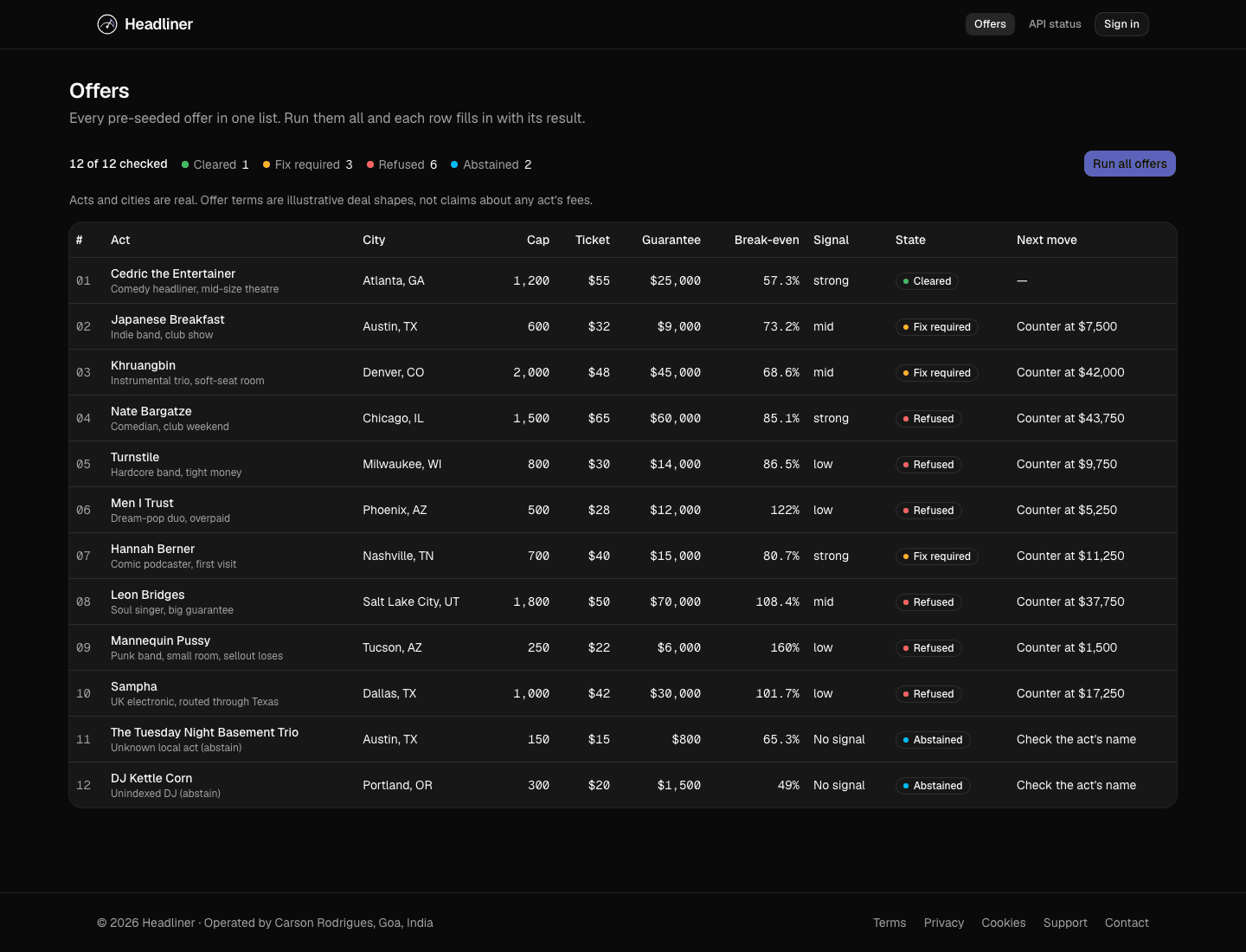
An independent promoter gets an offer sheet at 10 PM: this band, this city, this many seats, this ticket price, this much guaranteed to the act. The hold runs out at midnight, and one bad mid-week show can wipe out the profit from four good weekends.
I built Headliner to check that offer while it's still on the desk.
| Hackathon | Qloo Agentic Hackathon |
| Organiser | Qloo, on Devpost |
| When | 30 September to 30 October 2026; submissions closed 31 October, 09:15 IST |
| Field | 1,040 entries |
| Result and rank | Did not place. Three winners were named (Roomful, Backline, Undertow); no ranks published beyond those |
| Built in | About two weeks, from 17 October. The Qloo key arrived two days into the build |
| Team | Solo |
| Money spent | Not tracked. It ran on a server I already pay for, and the model calls for the comparison test weren't costed in my notes |
| Code | github.com/rodriguescarson/headliner (MIT) |
The hackathon
The Qloo Agentic Hackathon ran on Devpost. Qloo makes a "taste" API: it knows which people, places and brands share an audience.
Judges asked for a project that actually uses that API, then scored four things equally: technical work, design, potential impact and the quality of the idea. They could judge from the live site, the public code and the write-up alone.
What Headliner does
You type the offer the way it arrives: act, city, seats, ticket price, guarantee, room cost. Headliner answers with one of four words. Cleared, fix required, refused, or abstained.
It keeps three things apart. First, the money. Break-even tickets and net per ticket come from plain code and a written rulebook. No AI model ever touches a dollar.
Second, the audience. Qloo says whether this act's fans are really in this city, which age groups lean toward it, which local acts share its crowd and could open, and which brands those fans already buy. I treated that as evidence, never a ticket forecast.
Third, a plain list of what no data can tell you: other shows that night, radius clauses, actual sales, whether the act will take your counter.
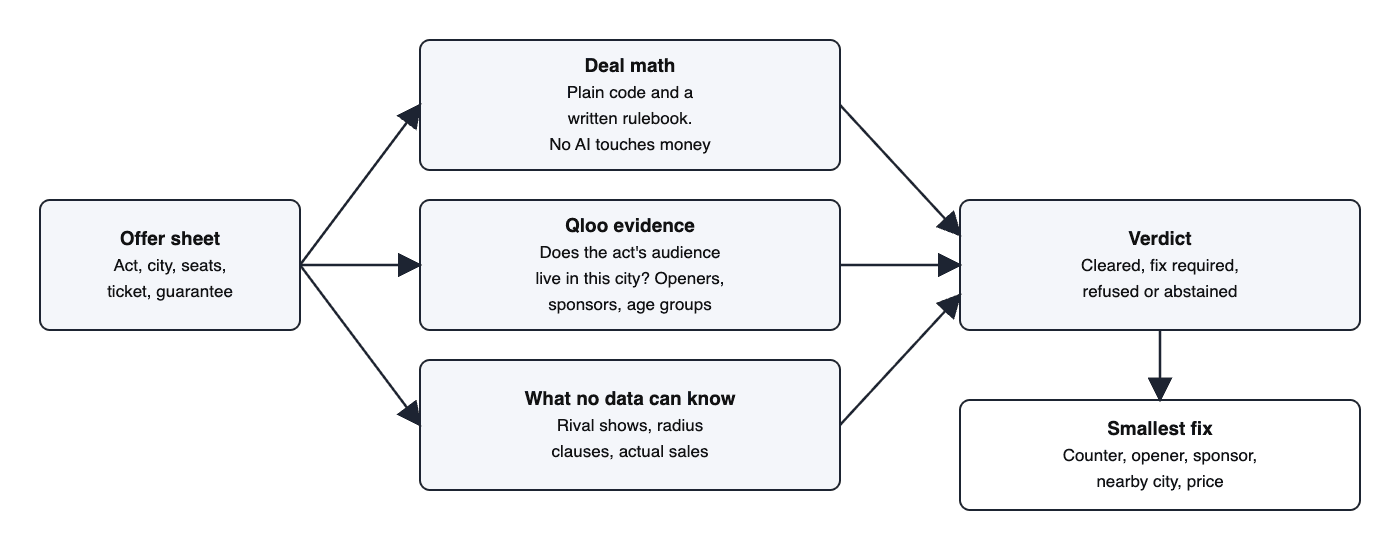
When the offer fails, it shows the smallest fix: a lower guarantee to counter with, an opener, a sponsor to cover the gap, or a nearby city that reads better. And when it can't tell, it says so. If Qloo has no exact match for an act, Headliner abstains and names the closest miss instead of borrowing its data.
Research
Primary research. The first real test of the API was a probe on the day my key arrived: 20 acts, 15 real and 5 invented, across five cities. After that I measured, instead of guessing, how strong a market looks for 15 acts in 5 cities. I also built twelve test offers from real acts and cities, with made-up deal terms. I didn't talk to any promoters, so I have no user interviews.
Secondary research. I read Qloo's rules and last year's hackathon: 2,893 participants, 344 submissions, and the winners GeoTaste, Alloy, Resonance AI and Zesty. Three of the four were consultant-style tools with a scored report, which is why I built for a buyer. I also checked trade reporting on touring (Pollstar's mid-year numbers, StubHub on mid-size venues): the biggest tours grew while per-show averages fell and costs rose.
How I tested it
Every number I published came from a script run against the real API, not from the sample data.
- The key-day probe. The first run was a failure worth having: all 20 acts "matched", but five matches were wrong, none of the 5 invented acts was rejected, and none of the 15 real acts had a usable city map. After fixes, 15 of 15 and 5 of 5.
- The cut-offs. My first "weak" and "strong" lines were made up. I replaced them with the thirds of a measured set of 75 act and city pairs (15 acts, 5 cities, 90 calls). I then checked that each act's best city matched what a promoter knows: Cedric the Entertainer in Atlanta, a Ukrainian metal band low everywhere.
- A control. Every check can also send the same offer to an AI model alone, no Qloo data. On the ten real acts the overlap was about 1% for openers and 1% for sponsors. The model never called a market weak, and Qloo's data called four of ten weak. The model named drinks brands for all ten acts, Qloo for one. For the two invented acts the model still made sponsor lists, and Qloo had nothing to say, which was right.
- Unit tests. 45 when I wrote the submission, covering the deal math, the counter-offer, parsing, verdicts, the evidence layer and storage.
What I didn't measure: which side is right on any one act. The control shows the two answer different questions, not that Qloo's picks sell tickets. I don't know what Qloo's affinity rank is ranked against, because its docs don't say. And no promoter has tried the counters.
What happened
It didn't place. The winners were Roomful, Backline and Undertow, out of 1,040 entries. Headliner wasn't one of them, and I found no ranking beyond the three winners.
I haven't studied the winners the way I did after my last hackathon, so I can't tell you what they had that I didn't. I'd rather not guess.
What I learned
Test the real API on day one. Until the key arrived I worked with sample data, and the first live run showed how much of that was wrong. A search for a made-up Goan band came back as Animal Collective. I'd sent one value in the wrong format and read a field that doesn't change between cities. A rate limit even showed up as "no brands found".
Measure instead of guessing. The cut-offs I made up before I had data would have been wrong. The ones I measured had a sanity check behind them.
Check your arithmetic advice. One idea for a fix was "try a smaller room". But with the same guarantee, a smaller room only raises the share of seats you need to sell. On one offer, break-even went from 122% to 163%. I dropped it and added "raise the ticket price" instead, capped at a 35% rise, because a bigger jump is a different show. That cap is a judgement call, and I flagged it as one.
Links
I shut the live demo down on 12 November, so there is no site to visit. The code is public and MIT-licensed.
Available · London / UK · senior AI, AI FDE, contract
Building something with AI?
Voice agents, MCP servers, LLM pipelines, agentic workflows — pick a slot, drop a message, or send your email and I'll reply within a day.
Replies within ~24 hours · London, UK · on-site, hybrid or remote