I built football commentary for blind fans. It didn't place. Here's what the winners did.

Carson Rodrigues / November 20, 2026
9 min read • ––– views
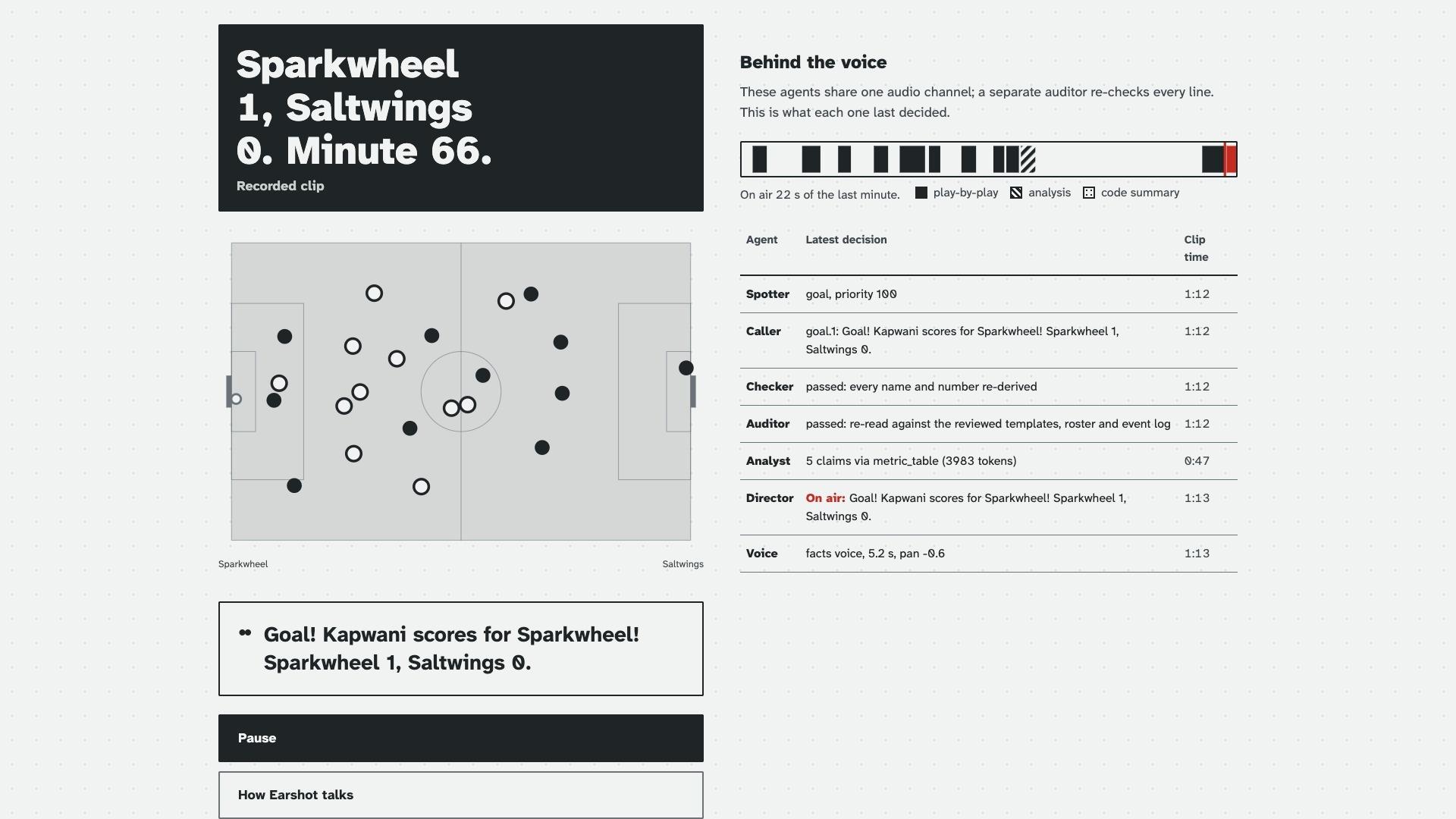
If you're blind and you love football, you mostly follow it by ear. And a live describer, someone who tells you who has the ball and where, only exists for a few matches.
In the UK this season, one broadcaster said it would describe about 109 of the 380 league matches. In English only.
So for the Microsoft x Premier League "Inside the Game" hackathon, I built Earshot: live commentary you follow by ear, on your phone, in English, Spanish, Arabic or Hindi.
It didn't place. 804 projects, 6 winners, and Earshot wasn't one of them.
I read every winner's write-up, repo and video the day the results came out. This is what I found.
| Hackathon | Inside the Game: Developer Hackathon, Best Multi-Agent Orchestration category |
| Organiser | Microsoft, with the Premier League |
| When | Submissions closed 27 October 2026; winners announced 19 November |
| Field | 2,031 registered, 804 projects |
| Result and rank | Did not place. Six winners were named and no other ranks were published |
| Built in | About two weeks: design on 14 October, submitted on 27 October |
| Team | Solo, with AI coding agents |
| Money spent | ₹3,525 on Azure (about $37), October to 21 November: the AI model ₹1,258, hosting ₹890, speech ₹841, the container registry ₹535 |
| Code | github.com/rodriguescarson/earshot |
What Earshot did
A voice tells you who has the ball and what just happened. Under it, a soft tone follows the ball from your left ear to your right as it moves up the pitch, and the crowd gets louder when an attack turns dangerous.
You can let Earshot speak, or send every line to your own screen reader at your own speed. Casual mode says what happened. Analyst mode adds the numbers.
Behind the voice there were eight agents. One spotted the moments worth saying, one wrote the line, two checked every name and number, one decided what got airtime when a goal went in.
The rule was simple: a listener who can't check what they're told should never be told something wrong.
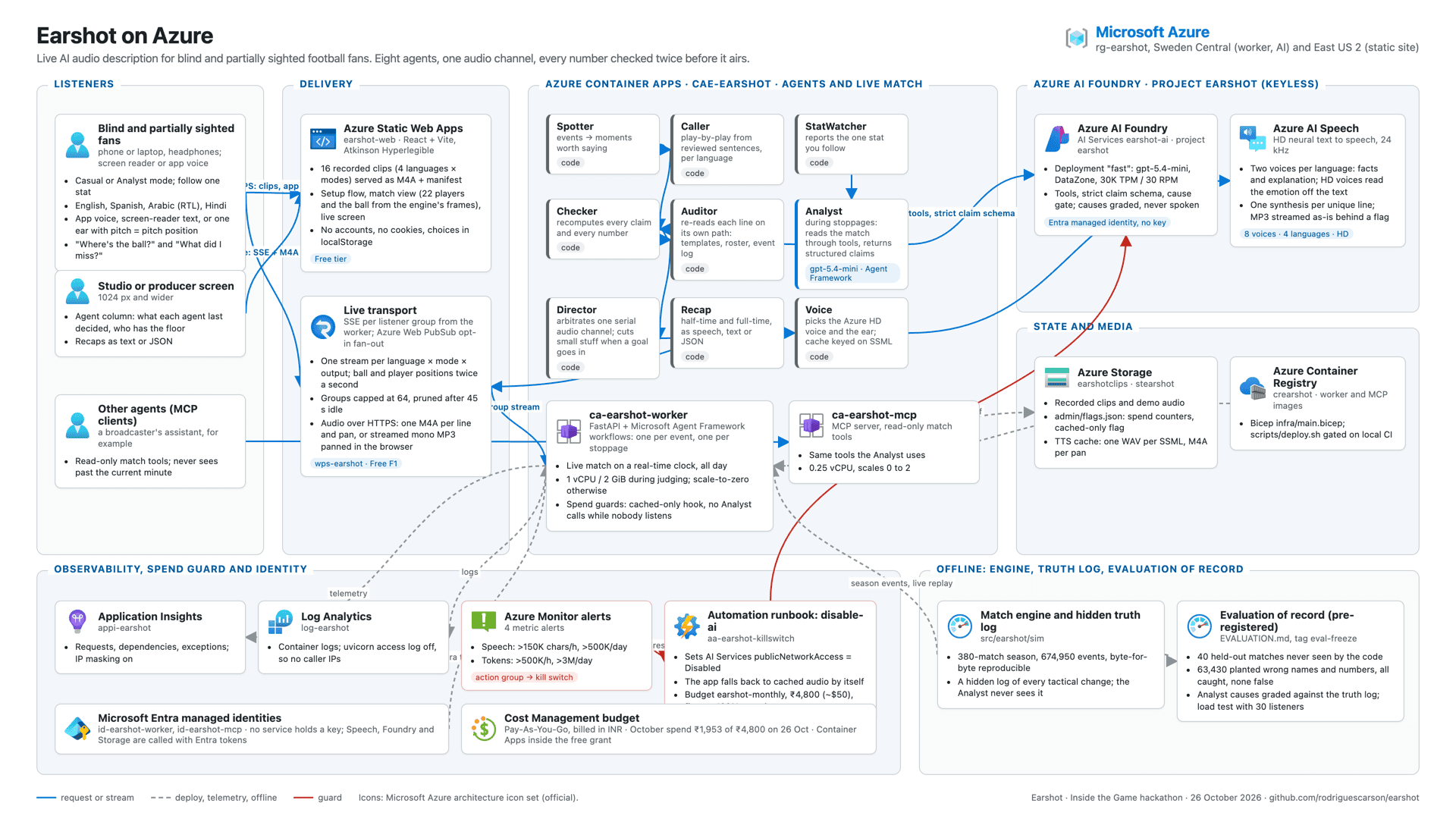
All of it ran on Azure. The eight agents lived in one container app and were wired together with Microsoft's Agent Framework. One of them called an AI model in Azure AI Foundry, Azure AI Speech supplied the voices, and every service signed in with a managed identity, so no key sat anywhere. A monthly budget and four usage alerts could switch the AI off, and the app then fell back to recorded audio by itself.
Research
Primary research was thin, and that's the first thing I'd change. I didn't talk to a single blind fan before or during the build. I wrote a listening test for blind testers before the deadline, with its pass marks fixed in advance, and it never ran. The first-hand work I did do was on the system itself: I picked the voices in a blind A/B test on the same goal line, and load-tested the live server with 30 listeners at once.
Secondary research was better. The 109-of-380 figure came from a Broadband TV News report on 8 October. Before building, I read the strongest entries already public in the field, which is how I decided to skip turning video into match events. After the results, I read all six winners' write-ups, repos and videos, and wrote up how each one compares with Earshot.
How I tested it
I wrote down what counts as a pass before running anything, and locked the code with a tag before the run that counted. Then I tested on 40 matches the system had never seen.
- The match engine had to pass ten checks before anything else ran, nine of them on a full 380-match season (674,950 events): realistic goals, shots, passing and cards, and the exact same output every run. It passed every one.
- I planted 63,430 wrong names and numbers across those 40 matches, in all four languages. The checks caught every one, and blocked no correct line.
- Every goal, red card and penalty aired across the full season, for every kind of listener.
- I asked the AI model to explain why a team changed its tactics, and graded it against a hidden log of what each team really did, which the model never saw. Over 2,322 model calls it was right 324 times out of 3,387, about 1 in 10 (between 7.4% and 11.8% with 95% confidence). A plain rule-based guess got 177 of 747, about 1 in 4. So Earshot never said why. I thought that was the honest call, and I still do.
- Two targets were missed and I published both. I wanted 95% of shots and cards spoken within 3 seconds; with 30 listeners it was 71% to 78%. I wanted the first sound within 2 seconds 95% of the time; it was 3.6 seconds.
- The code has about 240 automated tests, and a local check that has to pass before any merge or deploy.
What the six winners built
- Pitch Ledger, 1st overall. Its tagline: "AI gets the words. Code keeps the score." The AI writes the explanation, a separate checker recalculates every number from the raw match events, and a producer approves it before it airs. One whole match cost about 7 cents in AI calls.
- Footballytics, 2nd overall. A personal "director" follows your club and your fantasy team across ten matches at once and cuts to whatever matters to you. You can inflate a stat yourself and watch the checker reject it.
- Matchcut, best use of Microsoft Foundry. At full time it makes every fan their own voiced highlights film, in 7 languages, about 2 cents a film. Every film also comes in an audio-described version for blind fans.
- Absolute Scenes, best enterprise solution. An AI pundit that draws arrows on the pitch at the exact word it says them. Ask it what a team should have done and it tests the idea by replaying the moment.
- MatchCast, best multi-agent, my category. A whole broadcast crew of agents. A "Why?" button on every line shows where each number came from. A producer can approve, edit or kill a line.
- Talkback, best cloud native. An editor's desk for a whole matchday. It finds the stories people tuned in for, like a 100th goal or a farewell match, and it got 69% of them on air. One AI model on its own got 25%.
They're good. Go look at them.
What I got wrong
Every winner had a checker. All six had code that rechecks the AI's numbers before anything airs, and most planted fake errors to prove it. Mine was the biggest test of the lot, and it didn't matter, because it was the entry ticket. I spent most of my time on the part everyone had.
My AI had almost nothing to do. In every winner, the AI wrote the words and code checked the facts. In Earshot, code wrote the words too, from fixed sentences. The AI only picked which tactical changes to mention. And the one AI result in my demo video was the one where it lost to a simple rule. In an AI hackathon, that's a strange thing to lead with.
I never showed why eight agents beat one. My category asked for exactly that. MatchCast and Talkback both measured their team of agents against a single agent on the same data. I didn't.
There was no "Why?" button and no human in charge. All six winners let you click a line and see the evidence behind it. Four had a producer who approves what goes out. Earshot just played.
My README, the front page of the code, still said "Status: in development." Every winner's repo opens with a short path for a judge: open this, click that, here's the proof. Mine had a few developer commands. My own checklist told me to fix this. I didn't read it again before submitting.
And my whole product was a setting in their apps. Footballytics, Matchcut and MatchCast all had an audio-description mode. Earshot was only that mode. And the brief was written for a TV studio, while I built for the listener at home.
What I'd keep
The testing. Planting tens of thousands of mistakes and catching all of them is the reason I'd trust Earshot with a blind listener. And dropping the AI explanations when the numbers said they were wrong was right. I'd make the same call again.
I'd just stop treating that as the finish line.
What changes next time
- Give the AI a job it's actually good at, like writing the words, and show it beating one agent and a simple rule.
- Put a "Why?" behind every line, and a human approve button when the brief mentions a studio.
- Map every line of the brief to what I built, including what I didn't.
- Make the first screen of the README a 3-minute tour for a judge, and reread it the day before I submit.
- Before building something for one audience, check if it's a single setting in a bigger product. If it is, build the bigger product and make my idea its best setting.
The live demo is switched off now, and the cloud bill is back to zero. The code and results and the demo video are still up.
Microsoft's announcement of the winners is here.
Available · London / UK · senior AI, AI FDE, contract
Building something with AI?
Voice agents, MCP servers, LLM pipelines, agentic workflows — pick a slot, drop a message, or send your email and I'll reply within a day.
Replies within ~24 hours · London, UK · on-site, hybrid or remote